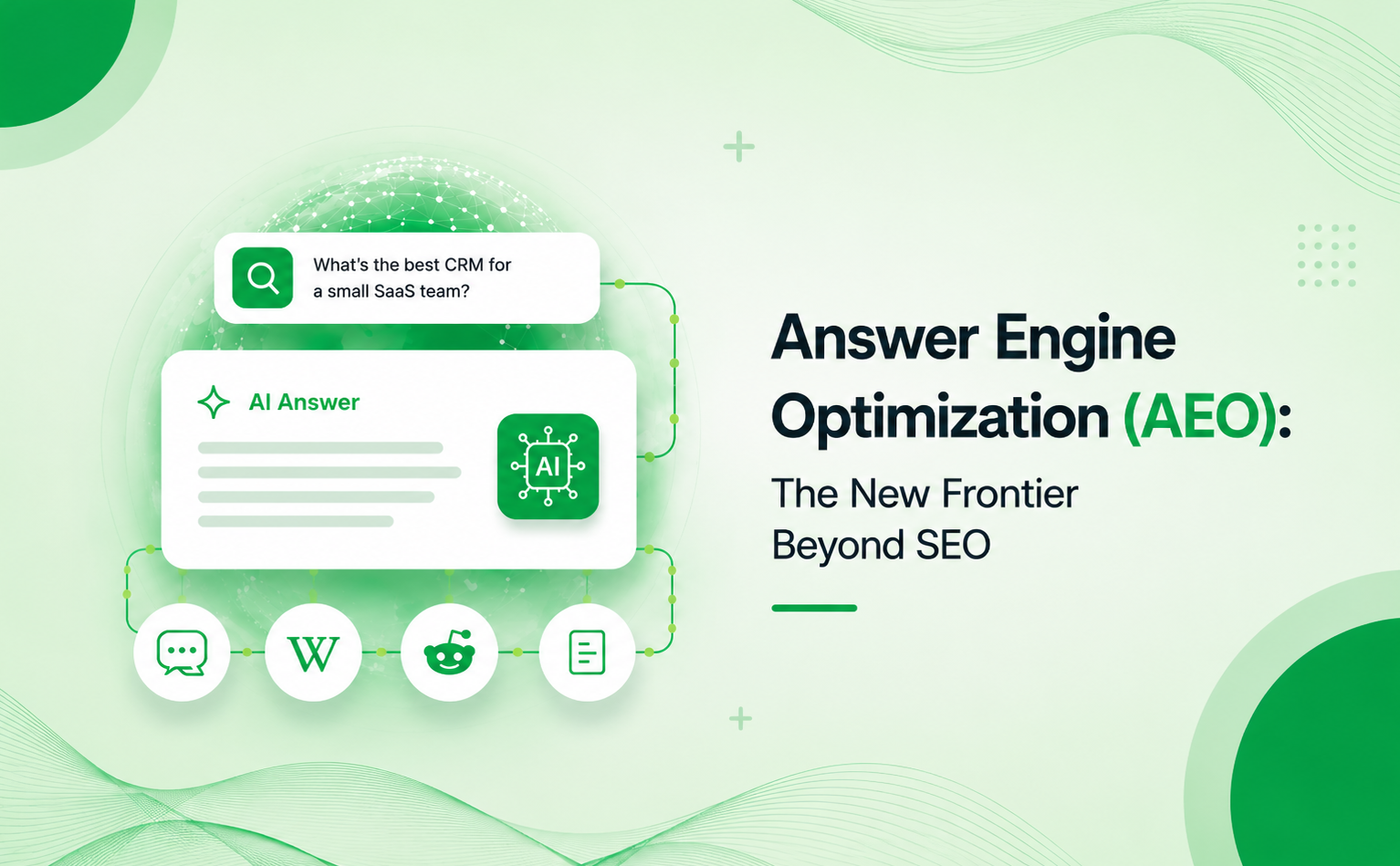
Answer Engine Optimization (AEO): The New Frontier Beyond SEO
Answer Engine Optimization (AEO)
The New Frontier Beyond SEO — And Why Your Business Can’t Afford to Ignore It
The way people search for information has fundamentally changed. Instead of typing a few keywords into Google and scrolling through ten blue links, users now ask ChatGPT, Claude, Perplexity, Gemini, and Google’s AI Overviews full questions — and expect a single, direct answer.
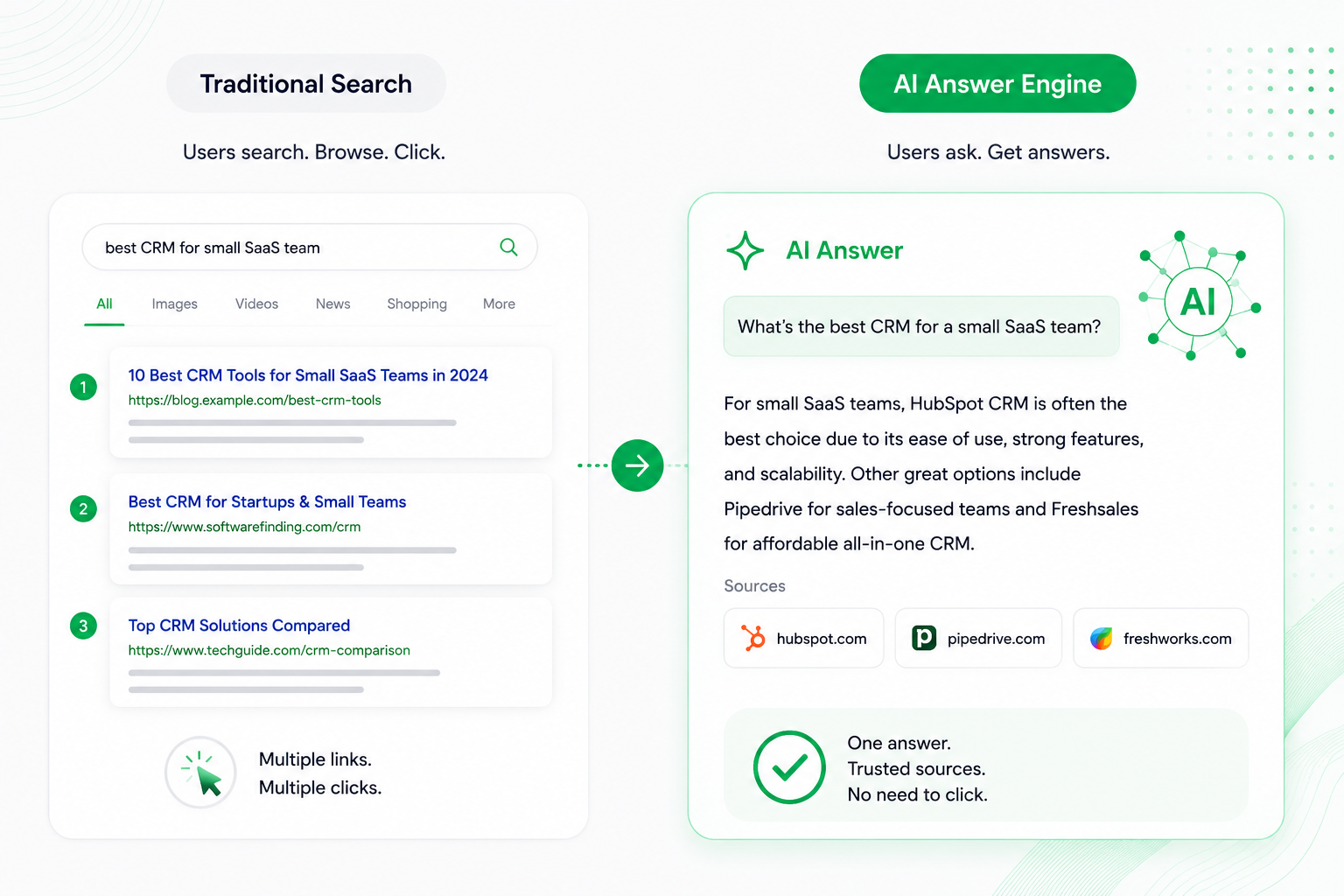
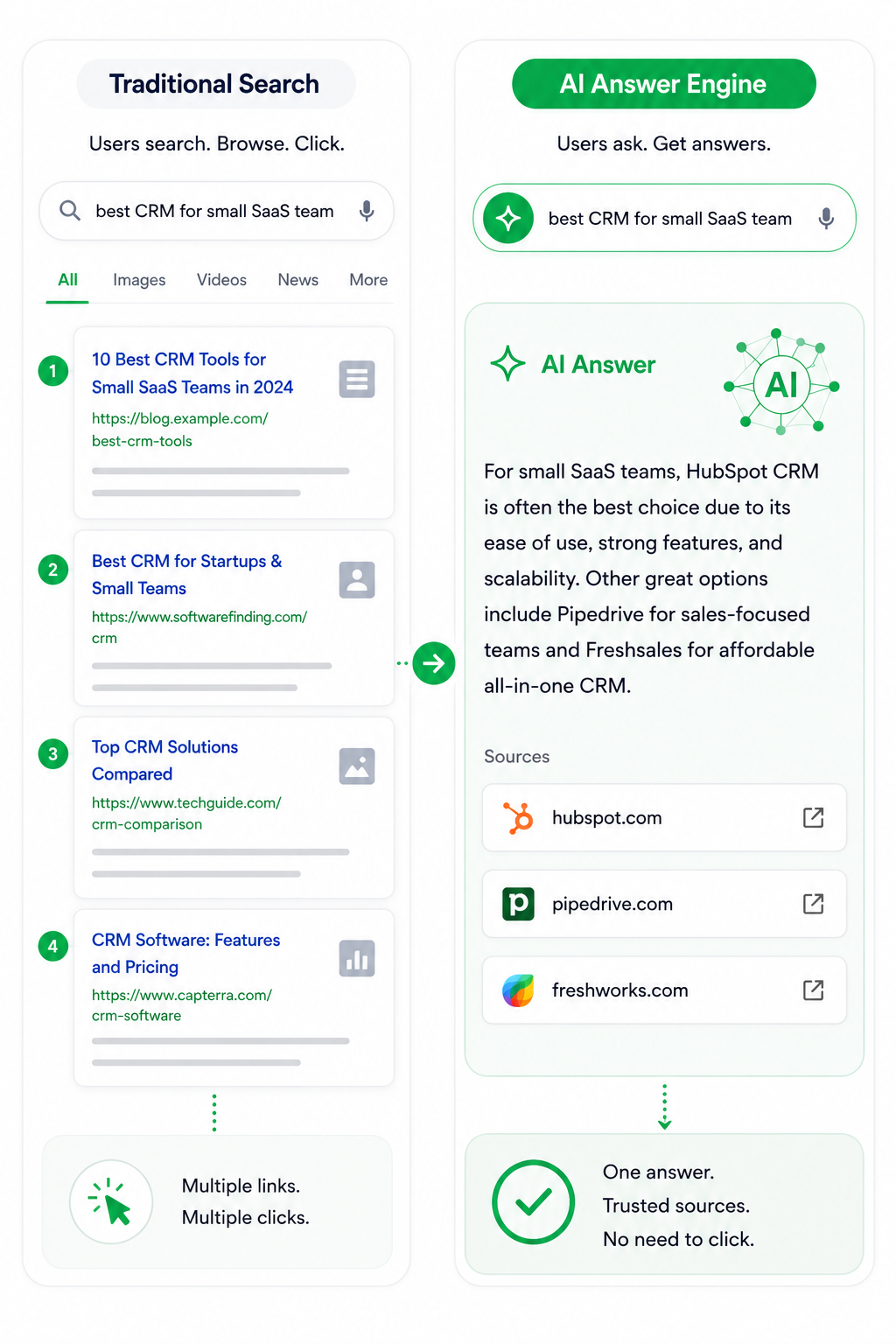
That answer is increasingly shaping what your customers believe about your brand, your products, and your industry. If your company isn’t visible in those AI-generated answers, you’re invisible to a fast-growing slice of the market. Welcome to the world of Answer Engine Optimization (AEO).
What Is AEO?
Answer Engine Optimization is the practice of structuring and positioning your content so that AI-powered answer engines surface, cite, or paraphrase your brand when users ask relevant questions. Where SEO aims to rank a page in a results list, AEO aims to make your brand the source of truth that an AI quotes back to the user.
It’s not about gaming an algorithm. It’s about earning the trust of language models, the same way you’d earn trust with a journalist or analyst through clear, authoritative, well-structured information that AI systems can confidently rely on.
Why AEO Matters Right Now
The numbers tell the story. ChatGPT alone serves hundreds of millions of weekly users. Google’s AI Overviews now appear above traditional search results for a growing share of queries. Perplexity, Claude, and Gemini are quietly becoming the default research tools for professionals, students, and decision-makers.
Click-through rates dropping: When the AI gives a direct answer, users don’t always need to click through to a website.
Brand perception: When someone asks for recommendations, the AI’s answer becomes their shortlist.
B2B research: Procurement decisions and vendor comparisons increasingly start inside an AI chat.
Window is open: AEO is where SEO was in 2005; early movers will compound their advantage.
If your competitors are showing up in AI answers and you aren’t, you’re losing deals you don’t even know you’re in.
SEO vs AEO: A Quick Comparison
| Dimension | SEO | AEO |
|---|---|---|
| Goal | Rank a page in search results | Become the source AI cites in answers |
| User outcome | User clicks through to your site | User gets the answer directly, often with attribution |
| Query style | Short keywords ("best CRM") | Conversational questions ("What CRM works best...?") |
| Success metric | Rankings, organic traffic, CTR | AI citations, share-of-voice, brand mentions |
| Content style | Keyword-optimized pages | Clear Q&A formats, definitions, structured facts |
| Authority signals | Backlinks, domain authority | Citations on Wikipedia, Reddit, primary data |
| Technical foundation | Crawlability, page speed, meta tags | Schema markup, llms.txt, semantic clarity |
| Time horizon | Months to rank | Faster signal pickup, compounds over time |
The good news: AEO doesn’t replace SEO. It builds on it. Most of the technical foundation overlaps, but AEO demands a sharper focus on clarity, credibility, and structure.
What AEO Looks Like in Practice
Here are some of the technical and content moves that make a real difference. These are the kinds of implementations a specialized AEO partner will deploy on your site.
1. Structured Data (Schema Markup)
Schema markup is structured data code in JSON-LD format added to your website HTML. It uses standardized vocabulary from Schema.org to define specific information like product names, FAQs, reviews, and organization level data. Schema converts human-readable text into structured, machine-readable data, allowing search engines to identify context, relevance, and entity salience accurately.
<script type="application/ld+json">
{
  "@context": "https://schema.org",
  "@type": "FAQPage",
  "mainEntity": [{
    "@type": "Question",
    "name": "What is Answer Engine Optimization?",
    "acceptedAnswer": {
      "@type": "Answer",
      "text": "Answer Engine Optimization (AEO) is the practice of structuring content so AI-powered answer engines like ChatGPT, Claude, and Perplexity surface and cite your brand when users ask relevant questions."
    }
  }, {
    "@type": "Question",
    "name": "How is AEO different from SEO?",
    "acceptedAnswer": {
      "@type": "Answer",
      "text": "SEO focuses on ranking pages in search results. AEO focuses on becoming the source AI cites in direct answers, with emphasis on structured data, conversational queries, and authority signals."
    }
  }]
}
</script>
2. Organization Schema for Brand Identity
Help AI engines understand who you are, what you do, and how you connect to other entities they already trust.
<script type="application/ld+json">
{
  "@context": "https://schema.org",
  "@type": "Organization",
  "name": "Abilytics",
  "url": "https://abilytics.com",
  "logo": "https://abilytics.com/logo.png",
  "description": "Abilytics helps companies win visibility in AI-powered answer engines through Answer Engine Optimization (AEO).",
  "sameAs": [
    "https://www.linkedin.com/company/abilytics",
    "https://twitter.com/abilytics"
  ]
}
</script>
3. The llms.txt File
A growing convention. It’s a plain-text file at the root of your domain that gives AI crawlers a clean, summarized view of your most important content similar in spirit to robots.txt or sitemap.xml.
# Abilytics


> Abilytics is a digital growth firm specializing in SEO, Answer

> Engine Optimization (AEO), and AI visibility strategy.


## About

- [Company Overview](https://abilytics.com/about): What Abilytics does and who we serve.

- [Services](https://abilytics.com/services): SEO, AEO, content strategy, and analytics.


## Resources

- [AEO Guide](https://abilytics.com/blog/aeo-guide): A complete primer on Answer Engine Optimization.

- [Case Studies](https://abilytics.com/case-studies): Client outcomes and measured impact.
4. Controlling AI Crawler Access
Modern robots.txt files now need to address AI-specific crawlers: GPTBot (OpenAI), ClaudeBot (Anthropic), PerplexityBot, and Google-Extended. You generally want to allow them, since blocking them removes you from those answer engines entirely.
User-agent: GPTBot
Allow: /


User-agent: ClaudeBot
Allow: /


User-agent: PerplexityBot
Allow: /


User-agent: Google-Extended
Allow: /


Sitemap: https://abilytics.com/sitemap.xml
5. Answer-First Content Structure
AI engines reward content that opens with a clear, self-contained answer before going into depth. A simple HTML pattern:
<article>
  <h1>What is Answer Engine Optimization?</h1>
  <p class="lede">
    Answer Engine Optimization (AEO) is the practice of structuring and
    positioning content so AI-powered answer engines like ChatGPT, Claude,
    and Perplexity surface and cite your brand when users ask questions.
  </p>
  <h2>Why AEO matters</h2>
  <p>...</p>
</article>
That opening paragraph is the part most likely to be lifted, paraphrased, or cited. Treat it as your “elevator pitch” for the AI.
Why You Need a Specialist Partner Like Abilytics
AEO sits at the intersection of disciplines that most in-house teams don’t have under one roof:
Technical SEO
Schema, site architecture, crawl optimization
Content strategy
Answer-first writing, topical authority, content clusters
Digital PR and authority building
Getting cited on sources that AI engines trust like Wikipedia and Reddit
AI visibility monitoring
Tracking how your brand appears across ChatGPT, Claude, Perplexity, and Gemini
Prompt auditing
Testing hundreds of prompt variations to find where you show up
Analytics and reporting
Parsing AI referral traffic and AI visibility dashboards
Where to Start
If you’re a marketing leader thinking about AEO, three honest questions to start with:
- When someone asks an AI about your category, what does it say and are you mentioned?
- When you are mentioned, is the framing accurate, current, and favorable?
- Do you have a system in place to influence those answers, or are you leaving it to chance?
The shift from search engines to answer engines is the biggest change in how customers find information since Google itself. AEO is how you stay visible through that shift.
Ready to see how your brand shows up in AI answers today? Get in touch with Abilytics for an AEO visibility audit.