Make schemas, quality rules, ownership and compatibility an explicit agreement between the teams that publish data and the teams that depend on it.
01The Pipeline Is Green. The Consumer Is Broken.
A producer can rename a field or change its meaning while its own tests still pass. Downstream jobs keep running, but they interpret the data incorrectly.
emailemail_addressLeaves downstream consumers reading NULLs. The pipeline succeeds, but downstream alerts, reports, and ML inference fail quietly.
CANCELLEDCANC_CUSTOMER / CANC_SELLERSplitting status values without notice makes downstream revenue logic count cancelled orders as revenue because filters like status != 'CANCELLED' silently pass.
The missing control is an explicit agreement about what a producer may change, what consumers may rely on, and how breaking changes are communicated.
02What Is a Data Contract?
A data contract is a versioned, machine-readable specification of a dataset’s interface. It states what the producer guarantees and what consumers may rely on.
The contract can live in Git beside the pipeline code. It defines schema and types, field meaning and allowed values, quality thresholds, freshness, accountable ownership and compatibility rules.
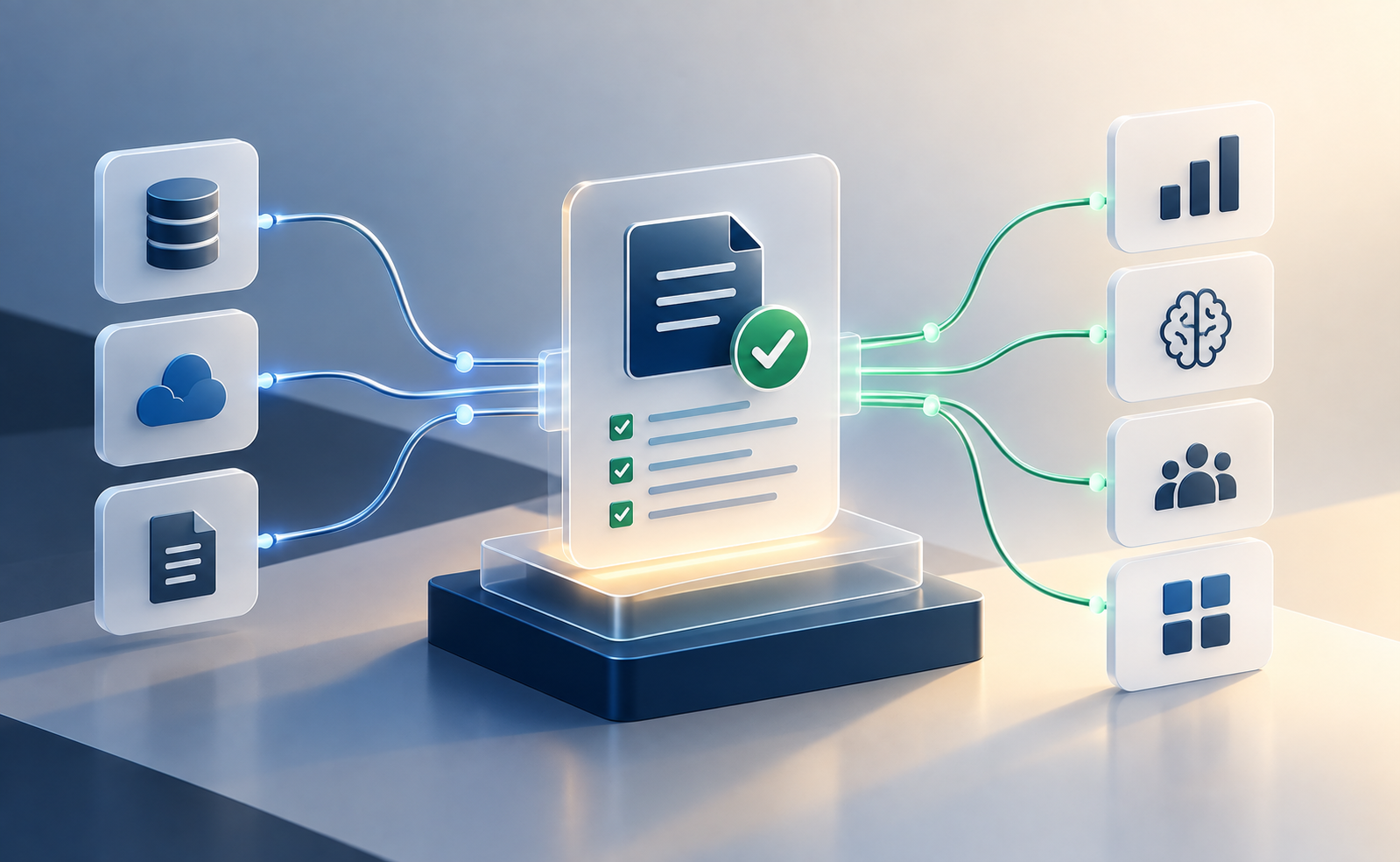
The contract sits between the team that publishes a table and the teams that build on it
Source Application or Upstream Pipeline Team
*owns the published table*
DATA CONTRACT — v2.3
Column names, hierarchy and structure
Types, nullability, precision, scales
Required fields, allowed ranges & values
Backward, forward, and full compatibility
Accountable team, escalation contacts
Update cadence, max latency & delay
Databricks SQL, Power BI, APIs
Feature store, training sets
Operational APIs, services
Retrieval indexes, agent memory
A contract violation is different from a normal quality blip. A few malformed rows may be within tolerance; a missing required column or an undeclared value breaks the producer’s promise.
An expectation is a check. The contract defines which checks exist — and who owns a failure.
03Producer vs Consumer: Who Owns What?
THE PRODUCER
- Publishes and versions the machine-readable contract in source control.
- Validates data before exposure to prevent corrupted writes from reaching contracted tables.
- Classifies changes explicitly as compatible or breaking before shipping updates.
- Announces breaking changes with an enforced deprecation window and migration plan.
THE CONSUMER
- Reads contracted columns by name, deliberately avoiding indiscriminate
SELECT *queries. - Tolerates only additive changes that the contract allows without expecting strict immobility.
- Registers dependencies in catalog lineage so upstream producers know who is affected by schema revisions.
Unity Catalog ownership tells people whom to contact. Enforcement still happens in pipelines, table constraints and CI.
04Compatible vs Breaking Changes
customer_id: STRING → BIGINT
This is not a safe type widening. Joins against existing STRING keys break and leading zeros are lost (for example, "00145" silently collapses into 145), so it should be published as a new contract version instead.
Other changes are less obvious. Whether a change breaks a consumer depends on how that consumer reads the data.
Example changes classified against a versioned contract
Add optional column
Potentially Compatible+ loyalty_tier STRING NULLNamed-column queries keep working. It can still break SELECT * into a fixed downstream schema.
Remove required column
Breaking- emailQueries that select, join or filter on email fail completely, or silently receive NULLs.
Change data type
Potentially Breakingcustomer_id STRING → BIGINTINT → BIGINT is a safe widening. STRING → BIGINT is not; leading zeros are permanently lost.
Rename column
Breakingstatus → account_statusTo a reader, a rename is a drop plus an add. References to status fail or return NULLs.
Delta Lake schema enforcement rejects unknown columns and incompatible types, while allowing supported safe widening such as INT → BIGINT. Schema evolution is opt-in:
mergeSchemaCan append new allowable columnsColumn mappingSupports renames & drops safelyType wideningCovers supported numeric wideningoverwriteSchemaCompletely rewrites table interfaceEnforcement protects the table, not the consumer. The contract defines which evolution is allowed, and pipeline settings should permit exactly that.
Backward compatible means existing consumers keep working. Forward compatible means upgraded consumers can still read older data.
Streaming raises the stakes. A Structured Streaming query fixes its schema at planning time, so an upstream schema change can stop the query until it is restarted.
05Implementing Contracts on Databricks
Databricks does not provide one single “data contract” feature. The contract is the specification; platform capabilities provide the enforcement and governance points.
| Contract Clause | Databricks Capability | Purpose & Enforcement |
|---|---|---|
| Schema & types | Delta schema enforcement; Auto Loader schema modes | Block incompatible changes; prevent unexpected fields from entering downstream |
| Required/value rules | NOT NULL and CHECK constraints | Fail violating writes directly at the Delta table layer |
| Quality rules | Lakeflow pipeline expectations | Warn, drop invalid records, or fail pipeline execution |
| Ownership & lineage | Unity Catalog owners, tags, lineage | Accountability, column-level consumer discovery, and impact analysis |
| Change & alerting | Git, CI, Bundles, Lakeflow Jobs | Test changes in pull requests, route notifications to contract owners |
For contracted sources, declare the Auto Loader schema explicitly and use rescue or failOnNewColumns mode, so schema drift is surfaced rather than silently absorbed.
06When a Contract Is Violated
The response should match the violation:
Missing required columns or type clashes: fail before publishing to protect downstream pipelines from poison pills.
Malformed data points: quarantine invalid rows for replay while valid rows continue uninterrupted.
Contract violation workflow: validate, contain, alert, remediate and revalidate
Data change
*new batch or schema*
Contract validation
Publish to production
*consumers read new data*
Fail update, reject batch or quarantine rows
Contract owner, issue failing notification
Fix, rollback, or publish new contract version
Rerun checks, replay quarantined data
Remediation belongs to the producer: roll back, fix the data, or publish a new version such as customers_v2 alongside customers_v1.
Use lineage to find affected consumers, migrate them during the deprecation window, then retire v1.
Contain the violation first, then route it to the owner who can fix it.
07A Practical Architecture
Place the contract boundary at the Silver or Gold tables consumers read, not at raw ingestion. Bronze can remain tolerant and retain unexpected fields in _rescued_data.
One versioned contract specification should drive ingestion and validation. CI checks proposed changes against the contract and lineage before deployment.
Contracts are enforced where consumers read; Bronze stays tolerant. Unity Catalog governs the flow.
The contract definition/change-control layer connects to the relevant ingestion and contract-check stages.
Sources
Ingestion
Bronze Delta
Preserves incoming state without strict filtering. Unexpected or drifted fields are safely captured in _rescued_data.
Contract checks (The Boundary)
*invalid rows kept for review and replay*
*failed update triggers, failure notification*
Contracted tables (Silver / Gold)
Only schema-conformant, verified, SLA-backed data exposed to enterprise users.
BI, SQL, ML, AI Applications
Unity Catalog
Governs the tables in the flow
08The Abilytics Perspective
Contracts make change deliberate. They will not prevent every pipeline failure, but they turn breaking changes into visible, owned and versioned decisions.
Start with the few tables that feed the most dashboards, models and AI applications. Define their contracts in Git, enforce them at the publish boundary, and connect lineage and CI to the change process.
The goal is simple: make a potentially silent production break become a visible engineering decision.
At Abilytics, we help enterprise data teams operationalize data contracts across Databricks Lakehouse environments — integrating Git CI/CD, Lakeflow pipeline expectations, and Unity Catalog lineage into seamless, bulletproof production architectures.
Want to prevent silent schema breaks and align producer-consumer boundaries in your organization?
Consult Our Architecture TeamSources:
Databricks documentation on schema enforcement, schema evolution, Auto Loader, pipeline expectations, constraints, Unity Catalog lineage, and job notifications.